

Add a webhook URL to a form under Destinations to forward every accepted message to your own app or automation as a signed HTTPS POST request.
Rondyr encrypts webhook signing secrets with RONDYR_SECRETS_KEY, which button deployments generate automatically. On an Alchemy deployment, make sure you set RONDYR_SECRETS_KEY_PROD first; see Deploy Rondyr.
1. Add a webhook in the dashboard
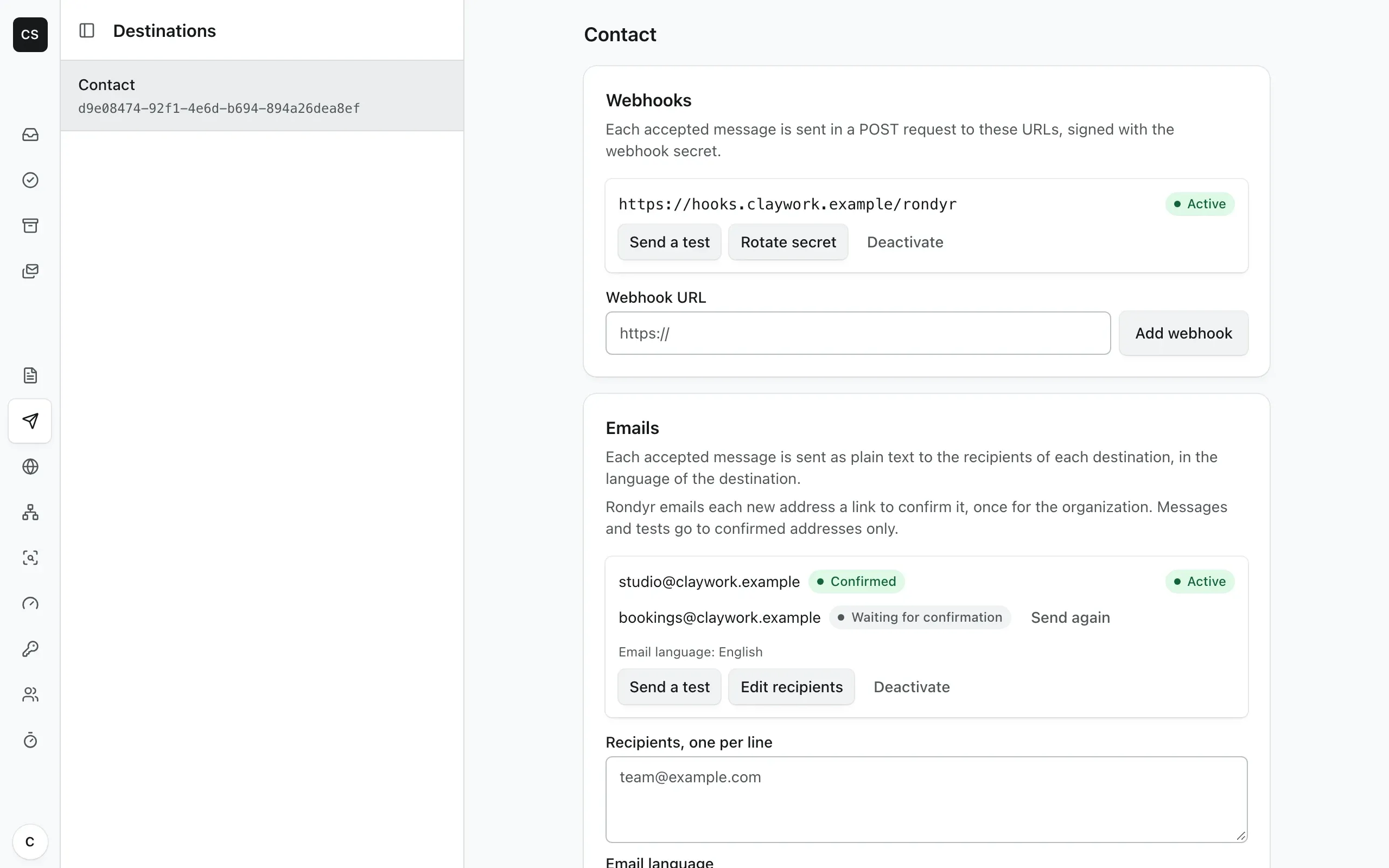
- Open Settings → Destinations (admins only) and select your form.
- Under Webhooks, paste your HTTPS endpoint URL (for example
https://hooks.claywork.example/rondyr) and select Add webhook. - Copy the signing secret (
whsec_…) shown immediately after creation and save it in your receiving app’s configuration. Rondyr shows a secret once and never again.
Only messages accepted after you create (or reactivate) a webhook are sent to it; quarantined messages go out only when someone accepts them.
2. Verify the signature
Every request includes Rondyr-Timestamp (Unix seconds) and Rondyr-Signature (v1=<hex>, or two comma-separated values during secret rotation). Rondyr signs <Rondyr-Timestamp>.<raw body> with HMAC-SHA-256 using the full secret string, whsec_ prefix included.
In your endpoint:
- Reject timestamps more than 5 minutes away from your clock.
- Verify the HMAC over the raw request body before parsing JSON.
- Accept the request if any
v1=signature matches in constant time.
Copy this Web Crypto helper (also at docs/examples/verify-webhook.ts); it runs in Cloudflare Workers, Node.js 20+, Deno, and Bun:
const toleranceSeconds = 300;const encoder = new TextEncoder();
function hexBytes(hex: string) {  if (!/^[0-9a-f]{64}$/u.test(hex)) return null;  return Uint8Array.from(hex.match(/../gu) ?? [], (pair) => Number.parseInt(pair, 16));}
/** * Returns the raw body of a Rondyr webhook request when one of its signatures * matches `secret` and its timestamp is at most five minutes away from `now`, * in milliseconds. Returns null otherwise. */export async function verifyRondyrWebhook(request: Request, secret: string, now = Date.now()) {  const timestamp = request.headers.get("rondyr-timestamp") ?? "";  const header = request.headers.get("rondyr-signature") ?? "";  if (!/^\d+$/u.test(timestamp)) return null;  if (Math.abs(now / 1000 - Number(timestamp)) > toleranceSeconds) return null;
  const body = await request.text();  const key = await crypto.subtle.importKey(    "raw",    encoder.encode(secret),    { name: "HMAC", hash: "SHA-256" },    false,    ["verify"],  );  const signed = encoder.encode(`${timestamp}.${body}`);  for (const part of header.split(",")) {    const [scheme, value = ""] = part.trim().split("=", 2);    const signature = scheme === "v1" ? hexBytes(value) : null;    // crypto.subtle.verify compares in constant time.    if (signature !== null && (await crypto.subtle.verify("HMAC", key, signature, signed))) {      return body;    }  }  return null;}
Example handler in a receiving Worker:
import { verifyRondyrWebhook } from "./verify-webhook.ts";
export default {  async fetch(request: Request, env: { RONDYR_WEBHOOK_SECRET: string }) {    const body = await verifyRondyrWebhook(request, env.RONDYR_WEBHOOK_SECRET);    if (body === null) return new Response(null, { status: 401 });    const payload = JSON.parse(body);    if (payload.type === "test") return new Response(null, { status: 204 });    // Store payload.deliveryId so duplicate deliveries are ignored.    return new Response(null, { status: 204 });  },};
3. Send a test request
Select Send a test on your webhook in Destinations (up to 3 tests per minute per destination). Rondyr signs and sends one request with "type": "test", waits up to 30 seconds without retrying, and reports whether your endpoint returned a 2xx status or an error. Make sure your receiver skips storing messages when payload.type === "test".
Payload and headers
POST /rondyr HTTP/1.1Content-Type: application/jsonUser-Agent: Rondyr-Webhook/1Rondyr-Delivery-Id: 1b4e28ba-2fa1-4d2b-883f-0016d3cca427Rondyr-Timestamp: 1795190400Rondyr-Signature: v1=5f2b…{ "version": 1, "type": "submission.accepted", "deliveryId": "1b4e28ba-2fa1-4d2b-883f-0016d3cca427", "submission": { "id": "73123ee4-40bf-4c5f-b8ff-1d56cdaa7640", "receivedAt": "2026-11-20T13:20:00.000Z", "fields": { "email": "visitor@example.com", "message": "Is there room in the pottery class?" } }, "form": { "id": "YOUR_PUBLIC_ID", "name": "Contact" }}version: always1for this shape; ignore unknown fields so future additions don’t break your receiver.type:"submission.accepted"for real messages,"test"for dashboard tests.deliveryId: same UUID asRondyr-Delivery-Id; stays identical across every retry of that delivery.submission.id: thesubmission-idreturned when the form was submitted.submission.receivedAt: UTC ISO 8601 timestamp of when Rondyr saved the submission.submission.fields: flat object of strings (1 to 32 fields).form.idandform.name: the form’s public ID and dashboard name.
Rotate a signing secret
Select Rotate secret next to a webhook in Destinations to generate a new secret. For the next 24 hours, Rondyr sends two signatures in Rondyr-Signature (new secret first, previous secret second) so you can update your receiver without downtime. After 24 hours, only the new secret signs requests. If a secret leaked, rotate it and update your receiver immediately so it stops accepting the old secret.
Retries and deduplication
Rondyr checks only your HTTP status code and ignores response bodies:
| Receiver response | Result |
|---|---|
2xx |
Delivered |
408, 425, 429, 5xx, network error, or no reply in 30 seconds |
Retried |
3xx (redirects aren’t followed) or any other 4xx |
Failed immediately |
Rondyr retries temporary failures automatically over several hours. If a delivery still ends as Failed, open the message in Accepted and select Retry delivery after fixing your endpoint.
Delivery is at-least-once and messages can arrive out of order. Always record Rondyr-Delivery-Id (or payload.deliveryId) so a retried delivery isn’t processed twice, and order messages by submission.receivedAt if order matters.
Allowed webhook URLs
Webhook URLs must use https:// on the default port (443) with no username or password, and must not target localhost, .local/.internal/.home.arpa hostnames, bare hostnames without a dot, private or reserved IP literals, or your Rondyr instance’s own host.